Introduction
Landscape edging defines the difference between ordinary yards and professionally finished outdoor spaces. That crisp line separating lawn from planting beds prevents grass invasion, reduces maintenance time, and can boost property value by up to 7%.
Well-defined landscape borders add an average of 7% to home sale prices, rising to 10-11% in slower markets. This financial impact explains why professionals avoid temporary solutions that fail within seasons and create ongoing replacement costs.
This guide explores professional-grade edging materials—from flexible aluminum systems to natural stone—helping landscape contractors and designers specify solutions that balance initial cost with decades of maintenance-free performance.
Key Takeaways
- Eliminate maintenance headaches with edging that separates lawns, beds, and pathways
- Metal edging lasts 30+ years with zero maintenance—wood and plastic can't compete
- Choose edging by lifetime value, not just sticker price
- Your climate and soil determine which materials perform best long-term
- Pro-grade edging cuts weeds, speeds mowing, and increases property value
Overview of Landscape Edging in Professional Landscaping
Landscape edging serves as the physical barrier separating different zones within your outdoor space—lawns from planting beds, pathways from garden areas, mulch from turf. It provides both aesthetic definition through clean visual lines and functional benefits by preventing material migration, reducing weed intrusion, and protecting plantings from mechanical damage during maintenance.
The professional landscaping market is shifting toward durable, long-lasting materials. The metal landscape edging sector is seeing robust growth, driven by increased home improvement spending and rising demand for products that provide genuine long-term value.
Market drivers include:
- Homeowners prioritizing materials that reduce lifecycle costs
- Professional contractors seeking to eliminate callbacks from premature failures
- Rising demand for low-maintenance solutions with extended performance
- Industry trends emphasizing durability over cheaper alternatives requiring frequent replacement
Professional contractors understand that temporary solutions create warranty claims and costly callbacks. Investing in quality edging removes the recurring expense and labor of replacing deteriorated materials every few years.
The following section explores the top landscape edging materials that deliver professional results, examining their specific performance characteristics, ideal applications, and long-term value propositions.
Top Landscape Edging Materials for Professional Results
The edging options below are selected based on durability, professional appearance, installation versatility, maintenance requirements, and value over time—the criteria that separate temporary fixes from permanent landscape solutions.
Aluminum Landscape Edging
Aluminum edging represents the premium standard in professional landscape edging, used for over 30 years in both commercial and residential projects.
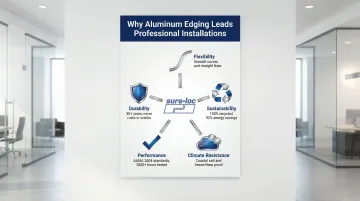
This lightweight yet durable material offers exceptional flexibility for curves while maintaining rigid straight lines, all manufactured from 100% recycled materials.
Key advantages that set aluminum apart:
- Never rusts, cracks, rots, or becomes brittle regardless of climate
- Natural corrosion resistance ideal for coastal installations where salt exposure destroys other materials
- High-performance coatings meeting AAMA 2604 standards withstand 3,000+ hours of humidity and salt spray testing
- Creates smooth curves and crisp straight lines with equal ease
- Recycling aluminum saves approximately 92% of energy compared to producing virgin metal
Professional manufacturers like Sure-loc Edging pioneered innovations in aluminum edging design, including no-overlap joint systems that create seamless installations.
| Feature | Details |
|---|---|
| Key Features | Lightweight aluminum construction, flexible for curves, no overlapping joints with professional locking systems, stake pockets for secure installation |
| Best Applications | Flower beds, tree rings, pathway borders, commercial landscapes, any project requiring permanent, maintenance-free edging |
| Considerations | Higher upfront cost than plastic or basic options, but lowest lifetime cost due to durability; professional installation recommended for best results |
Steel Landscape Edging
For applications requiring maximum strength, steel edging delivers heavy-duty performance in commercial projects and high-traffic areas. Available in galvanized or powder-coated finishes, professional specifications range from 14 gauge (approximately 0.075") to heavy-duty 1/4" thickness.
Municipal projects often specify robust 3/16" dimensions.
Steel's exceptional strength makes it ideal for sloped areas requiring erosion control and challenging soil conditions. The clean, modern aesthetic appeals to contemporary design schemes.
Hot-dip galvanizing governed by ASTM A123 creates a protective zinc layer that shields underlying metal even when scratched, often outlasting powder coatings in demanding environments. Quality powder coats last 15-20 years when applied over proper surface preparation.
| Feature | Details |
|---|---|
| Key Features | Heavy-gauge steel construction, galvanized or powder-coated finishes, rigid yet bendable for gentle curves |
| Best Applications | Sloped landscapes, erosion-prone areas, commercial properties, modern design aesthetics, areas with challenging soil conditions |
| Considerations | Heavier than aluminum; galvanized steel may develop patina over time; requires proper surface preparation for powder coating to last |
Natural Stone Edging
Natural stone—including fieldstone, river rock, and flagstone—offers timeless, organic edging that blends seamlessly with natural landscapes. This versatile option provides rustic or elegant appearance depending on stone type and can often be sourced locally, reducing transportation costs and environmental impact.
Stone edging allows for creative, irregular patterns that complement cottage gardens and natural design schemes.
Proper installation requires a stable compacted aggregate base or sand/concrete foundation with reinforcing rods. Set stones at least 3 inches thick and 4 inches wide to effectively stop grass intrusion. Polymeric sand in crevices binds stones while preventing weed growth, though apply only under dry conditions.
| Feature | Details |
|---|---|
| Key Features | Natural appearance, variety of sizes and colors, irregular shapes create organic look, can be mortared or dry-laid |
| Best Applications | Cottage gardens, natural landscapes, curved beds, tree rings, rustic design schemes |
| Considerations | Labor-intensive installation; stones can shift over time without proper base; grass and weeds can grow between stones; requires periodic maintenance |
Cost considerations are significant: material costs range from $12 per linear foot for basic fieldstone to $70 per linear foot for granite, with professional installation adding $36-$100 per linear foot depending on stone weight and site accessibility.
Brick and Concrete Paver Edging
Brick and concrete pavers offer classic, formal edging with versatile installation patterns including soldier course (pavers standing upright), basket weave, and running bond. These materials complement traditional architecture and can match existing hardscaping for cohesive design.
Wide ranges of colors and styles provide design flexibility. For freeze-thaw climates, ASTM C936 requires concrete pavers to resist at least 50 freeze-thaw cycles with average material loss not exceeding 1%.
A well-compacted dense-graded aggregate base at 98% standard Proctor density provides essential stability. Edge restraints spiked into the base prevent spreading.
| Feature | Details |
|---|---|
| Key Features | Multiple installation patterns, variety of colors and textures, can be set flush with lawn for easy mowing, formal appearance |
| Best Applications | Traditional landscapes, formal gardens, matching existing patios or walkways, straight borders |
| Considerations | Requires proper base preparation (sand, gravel) to prevent shifting; can crack in freeze-thaw cycles; grass can grow between pavers without proper installation |
Polymeric sand filling joints creates a hardened barrier resisting weed growth, while concrete collars provide maximum stability for high-traffic areas.
Plastic Landscape Edging
Plastic edging offers an economical, DIY-friendly option available in various styles including pound-in strips, roll edging, and interlocking sections.
Manufactured from HDPE or LDPE polyethylene, this material provides the lowest initial cost and easiest installation for budget-conscious projects.
Key advantages include lightweight construction, flexibility for curves, various color options, and easy transport. Durability challenges are significant, though.
ASTM D2565 and D4329 testing reveals that UV exposure degrades polymers, causing brittleness and discoloration without proper stabilizers. Black plastic edging lasts only several years before requiring replacement, degrading faster in full sun. Cold climate brittleness and freeze-thaw cracking represent common failure modes.
| Feature | Details |
|---|---|
| Key Features | Polyethylene construction, flexible, various depths available, pound-in or stake installation, budget-friendly |
| Best Applications | Residential flower beds, curved borders, temporary installations, DIY projects, budget-conscious landscaping |
| Considerations | Can become brittle in extreme cold; may not provide professional appearance; visible above ground can detract from aesthetics; shorter lifespan than metal or stone |
Plastic edging is difficult to keep stable, often heaving out of the ground during frosts unless anchored with deep steel stakes or specialized designs.
Wood and Landscape Timber Edging
Wood edging, including landscape timbers, railroad ties, and logs, provides natural, rustic appeal that works well for raised beds and cottage-style gardens. This material creates warm aesthetics and can be stacked for height, making it suitable for sloped areas requiring terracing.
Durability depends heavily on wood species and treatment. Naturally rot-resistant species like redwood, cypress, and cedar offer premium durability but command higher prices.
Pressure-treated lumber extends service life significantly. Current preservatives like Micronized Copper Azole (MCA) and Alkaline Copper Quaternary (ACQ) replace older CCA treatments phased out in 2003 due to arsenic concerns.
| Feature | Details |
|---|---|
| Key Features | Natural wood appearance, variety of sizes, can be stacked for height, creates warm aesthetic |
| Best Applications | Raised beds, rustic landscapes, vegetable gardens, sloped areas requiring terracing |
| Considerations | Limited lifespan (5-15 years depending on wood type and treatment); can rot, warp, or attract pests; requires periodic replacement; treated wood may contain chemicals |
Wood labeled for "ground contact" is essential for edging applications, and proper anchoring with rebar or long spikes prevents movement.
How to Choose the Best Landscape Edging for Your Project
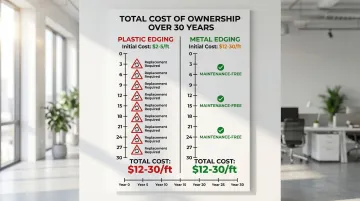
Selecting landscape edging based solely on initial cost is the most common—and expensive—mistake. Materials purchased for $3 per linear foot that require replacement every 3-5 years cost far more than premium options lasting 30+ years. Understanding total cost of ownership transforms the selection process.
Common Selection Mistakes:
- Ignoring climate suitability (freeze-thaw cycles, UV exposure intensity)
- Choosing materials incompatible with soil type (sandy soils require deeper anchoring)
- Underestimating installation complexity for DIY projects
- Overlooking long-term maintenance requirements and replacement costs
Beyond avoiding these mistakes, four factors determine the right edging for your project:
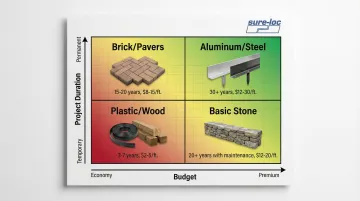
- Material longevity: Aluminum and steel last 30+ years with minimal degradation, while plastic lasts 3-7 years and wood 5-15 years depending on treatment
- Maintenance needs: Metal requires zero maintenance after installation, while wood needs periodic replacement and stone may need re-leveling
- Installation method: Plastic and wood suit DIY installation with basic tools, while professional installation ensures proper results for aluminum, steel, and stone
- Climate compatibility: Freeze-thaw zones require flexible systems like aluminum or pavers meeting ASTM C936 standards, while high UV zones demand powder-coated metal or UV-stabilized plastics tested to ASTM D2565
Total Cost of Ownership Calculation:
These factors directly impact your long-term costs. Life-cycle cost analysis accounts for initial cost, installation labor, maintenance expenses, and replacement frequency. Operation and maintenance costs over 30 years often exceed initial construction costs.
While plastic edging costs $2-$5 per foot initially, replacement every 3-5 years totals $12-$30 per foot over 30 years. Metal edging at $12-$30 per foot upfront requires no replacement, delivering lower total cost with superior performance.
Match edging material to project scale. Residential gardens may justify premium materials for permanent results, while temporary installations or rental properties might prioritize lower initial investment.
Commercial and institutional projects should prioritize durability to minimize maintenance disruption and lifecycle costs.
Conclusion
The best landscape edging balances upfront investment with long-term performance, requiring minimal maintenance while delivering the professional appearance that enhances property value and reduces ongoing labor. Materials matter: aluminum and steel provide decades of maintenance-free service, natural stone offers timeless beauty with proper installation, while plastic and wood serve temporary needs at lower initial cost.
Before selecting edging material, evaluate your specific conditions:
- Does your region experience harsh freeze-thaw cycles?
- Is your soil sandy, requiring deeper anchoring?
- Does your design feature tight curves or primarily straight runs?
- What's your realistic timeline for replacement and maintenance?
Answering these questions guides you toward materials that will perform reliably in your unique environment.
For permanent, maintenance-free solutions, Sure-loc Edging manufactures aluminum and steel edging products designed specifically for landscape professionals and discerning homeowners. Our products deliver lifetime performance that eliminates ongoing replacement costs.
With over 30 years of manufacturing experience and installations at prestigious projects including the Flight 93 Memorial and Citizens Bank Park, Sure-loc's proprietary locking systems and anti-frost heave technology deliver the crisp lines and lasting durability that transform good landscapes into exceptional outdoor spaces.
Frequently Asked Questions
What to put around the edge of a patio?
Patio edging options include concrete pavers, natural stone, brick, or aluminum/steel edging, with the best choice depending on your patio material and desired formality. Metal edging provides clean separation with minimal visual intrusion, while pavers set level with turf simplify mowing.
What is the most durable landscape edging material?
Aluminum and steel edging offer the longest lifespan—often 30+ years or lifetime performance. Aluminum never rusts, while quality powder-coated steel provides decades of service. Natural stone is also durable but requires proper base installation to prevent shifting.
How deep should landscape edging be installed?
Most edging should be installed 4-6 inches deep to effectively stop grass roots, with deeper installation up to 10-12 inches needed for sandy soils or areas with aggressive grass like Bermuda or zoysia. Depth also depends on weed barrier needs and whether you're dealing with rhizomatous grasses that spread underground.
Can I install landscape edging myself or should I hire a professional?
Plastic and some brick edging are DIY-friendly with basic tools (spade, hammer, level), while professional installation is recommended for aluminum, steel, and complex stone projects. Proper base preparation, precise alignment, and correct anchoring techniques significantly impact longevity, making professional installation worthwhile for permanent materials.
How do I prevent grass from growing over landscape edging?
Install edging with the top edge about 1 inch above soil level, creating a physical barrier grass cannot easily cross. Combine this with 4-6 inches of depth to prevent underground root penetration, plus regular monitoring with hand-pulling or spot treatment of any grass attempting to cross.
What is the best edging for curved garden beds?
Flexible materials like aluminum edging, plastic edging, and steel edging (with appropriate radius specifications) work best for curves, bending smoothly without cutting or special forming. Brick and pavers require cutting and careful placement for curves, while rigid materials like landscape timbers are best reserved for straight lines or very gentle curves.