Metal edging lifespan varies dramatically based on four critical factors: material type (aluminum, weathering steel, galvanized steel, or stainless steel), environmental conditions (coastal salt exposure, soil pH, freeze-thaw cycles), material quality (gauge thickness, manufacturing standards), and installation practices. Understanding these variables helps you select edging that will actually last decades, not just years.
TLDR: Key Takeaways
- Aluminum edging lasts 25-50+ years with zero rust and minimal maintenance
- Weathering steel delivers 20-50+ years in dry climates with proper wet/dry cycles
- Galvanized steel provides 20-30 years until zinc coating degrades
- Grade 316 stainless steel offers 40-50+ years in coastal environments
- Thicker materials last longer: 3mm+ steel outlasts 1.5mm by 3x
How Long Does Metal Garden Edging Last? The Quick Answer
Metal garden edging lifespans vary significantly by material type and quality:
| Material Type | Expected Lifespan |
|---|---|
| Aluminum | 25-50+ years |
| Weathering Steel (Corten) | 20-50+ years (environment-dependent) |
| Galvanized Steel | 20-30+ years |
| Stainless Steel | 40-50+ years |
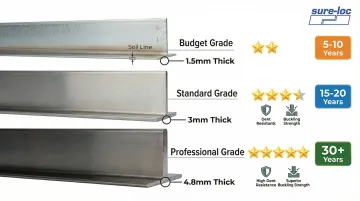
Material thickness plays a crucial role. For example, 3mm+ Corten steel lasts 15-30 years compared to just 5-10 years for 1.5mm variants.
Why Metal Outlasts Alternatives
Metal edging significantly outlasts other materials:
- Plastic edging: 1-10 years (UV degradation causes brittleness)
- Wood edging: 7-15 years (rot and termite damage)
- Concrete edging: 15-30 years (cracking from freeze-thaw cycles)
Unlike plastic that becomes brittle under UV exposure or wood that rots, metal maintains structural integrity for decades. Metal's superior longevity justifies higher upfront costs, delivering lower total cost of ownership.
Manufacturer Warranties vs. Actual Lifespan
While warranties provide useful benchmarks, actual performance often exceeds manufacturer guarantees:
- Typical manufacturer warranties: 10-20 years
- Aluminum products commonly carry 15-year limited warranties
- Premium manufacturers offer lifetime guarantees against defects
Real-world installations prove these conservative estimates. Sure-loc Edging installations from the 1990s continue performing at IBM Computers Headquarters, Citizens Bank Park, and the Flight 93 Memorial. These projects demonstrate that properly manufactured metal edging routinely exceeds 30 years of service.
Lifespan Definitions: Structure vs. Appearance
"Lifespan" means different things for different applications:
- Structural integrity: When edging can no longer hold its shape or retain soil
- Aesthetic appearance: When surface finish degrades enough to affect visual appeal
Weathering steel intentionally develops a rust patina within 6-12 months; this is expected and desirable. However, rust-through or structural perforation indicates true end-of-life failure.
Types of Metal Edging and Their Lifespans
Aluminum Edging
Aluminum edging delivers 25-50+ years of service because it never rusts. The material forms a natural aluminum oxide layer upon air exposure that seals the underlying metal from environmental attack.
This self-healing oxide layer reforms instantly if scratched, providing continuous protection without maintenance.
Key Performance Characteristics:
- Never rusts (contains no iron to form iron oxide)
- Lightweight yet durable (withstands maintenance equipment abuse)
- Stable in soil pH ranges between 4.5-8.5
- Gains strength in sub-zero temperatures
Gauge Thickness and Quality
Commercial-grade aluminum uses significantly thicker material than residential products. Professional specifications include:
- 1/8" (0.125" or 3.2mm): Standard for residential and light commercial applications
- 3/16" (0.187" or 4.8mm): Commercial and high-traffic areas
- 1/4" (0.25" or 6.4mm): Heavy-duty applications like driveways
Sure-loc's commercial-grade aluminum edging uses these thicker gauges combined with 6063 alloy (containing magnesium and silicon for enhanced corrosion resistance) in T5 temper for maximum strength.
Their proprietary design eliminates overlapping joints—the primary failure point where deterioration typically starts in conventional systems. The dual stake system allows staking at any point, eliminating installation errors that create stress concentrations. This comprehensive engineering approach explains why properly manufactured aluminum edging can exceed 40 years of service even in challenging environments.
Weathering Steel (Corten Steel)
Weathering steel can last 20-50+ years, but this range is highly environment-dependent.
How the Protective Patina Works:
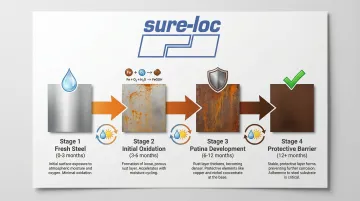
The rust patina forms within 6-12 months (sometimes up to 24 months) and reduces the corrosion rate to approximately 2-5 microns per year, creating a self-healing protective layer where scratches naturally re-oxidize and seal.
Critical Environmental Requirements:
Corten requires specific conditions to develop its protective patina:
- Wet/dry cycles: Alternating moisture and drying periods are essential
- Neutral to alkaline soils: pH 6-8 is ideal
- Good drainage: Constant moisture prevents proper patina formation
When Corten Fails Prematurely:
In coastal areas or regions with high de-icing salt use, salt prevents the stable oxide layer from forming, reducing lifespan from 50+ years to just 5-15 years. Similarly, acidic soils with pH below 6 can accelerate corrosion, potentially halving the lifespan to 5-10 years.
Continuously saturated soil or poor drainage causes Corten to corrode like mild steel because the protective patina cannot stabilize.
Some suppliers explicitly state "No warranties" for weathering steel products due to these environmental variables.
Galvanized Steel Edging
Galvanized steel typically lasts 20-30+ years, depending on zinc coating thickness and environmental conditions.
The zinc coating provides both a physical barrier and galvanic (sacrificial) protection—if scratched, surrounding zinc corrodes first to protect the underlying steel.
Coating Thickness Matters:
A G90 coating (0.9 oz/ft² total) provides approximately 0.76 mils of protection per side. Doubling the coating thickness roughly doubles the service life.
Environmental Vulnerabilities:
Galvanized steel degrades rapidly in:
- Highly acidic soils (pH < 5)
- Highly alkaline soils (pH > 10)
- High soil moisture (>17.5%) combined with chlorides
The ideal soil pH range for galvanized steel is 5-10. Once the zinc coating is consumed, the base steel forms "red rust" (iron oxide), which is porous and allows moisture penetration, causing rapid structural failure.
Stainless Steel Edging
Stainless steel offers 40-50+ years of service with superior corrosion resistance. The material contains minimum 10.5% chromium, which forms a passive chromium oxide film that is non-reactive and self-renewing.
Grade Selection:
- Grade 304: Excellent resistance in most environments but susceptible to pitting in high-chloride settings
- Grade 316: Contains 2-3% molybdenum for drastically improved resistance to chlorides and acids—the "marine grade" choice
Grade 316 is strongly recommended for coastal properties, areas with heavy de-icing salt usage, or soils with high salinity. While stainless steel is the most expensive option, its ability to withstand environments that would destroy other metals makes it cost-effective for extreme conditions.
Material Comparison Table
| Material | Lifespan | Maintenance | Relative Cost | Best Application |
|---|---|---|---|---|
| Aluminum | 25-50+ years | Minimal | $$$ | General purpose, versatile |
| Weathering Steel | 20-50+ years* | Minimal* | $$$$ | Dry inland climates only |
| Galvanized Steel | 20-30 years | Low | $$ | Budget-conscious, moderate climates |
| Stainless Steel | 40-50+ years | Minimal | $$$$$ | Coastal, high-salt environments |
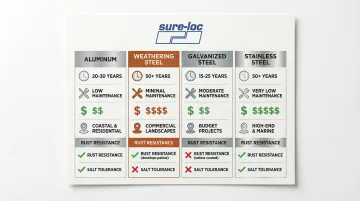
*Weathering steel performance is highly environment-dependent
Factors That Affect Metal Edging Longevity
Climate and Weather Conditions
Freeze-Thaw Cycles:
Aluminum gains strength in sub-zero conditions, making it ideal for cold climates. The primary risk is mechanical heaving—frost movement can push edging out of position. Grooved stakes or extra-long stakes (15-18 inches) help anchor edging against frost movement.
Coastal Environments and Salt Exposure:
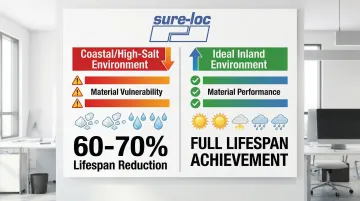
Salt exposure creates dramatically different outcomes by material:
- High risk: Corten steel and galvanized steel suffer accelerated corrosion
- Low risk: Aluminum naturally resists salt corrosion
- Lowest risk: Stainless steel Grade 316 offers highest resistance
In coastal areas, choosing the wrong material can reduce expected lifespan by 60-70%.
UV Exposure:
Unlike plastic edging that becomes brittle and cracks due to photodegradation, metal edging is immune to UV damage. Powder coatings may fade over time, but structural metal remains intact.
Soil Chemistry and Moisture
Acidic Soils:
Soils with pH below 6 are aggressive to Corten and galvanized steel. Aluminum remains stable down to pH 4.5, making it the better choice for acidic soil conditions.
Saturated soil from poor drainage creates oxygen-depleted conditions that accelerate microbial corrosion. For Corten steel, constantly wet conditions prevent the protective patina from forming, causing the steel to corrode like mild steel.
Organic Matter:
Decaying mulch and leaves produce organic acids. Direct contact with deep layers of wet organic matter can cause pitting in metals, particularly at the soil line where moisture accumulates.
Material Thickness and Quality
Thickness Directly Correlates with Lifespan:
Industry data shows that thickness is one of the most critical factors:
- 3mm Corten lasts 3x longer than 1.5mm Corten
- Thicker gauges provide exponential benefits in dent resistance and buckling prevention
Professional-grade products use thicker material than big-box retail versions:
- Residential standard: 1/8" (3.2mm) aluminum or 14-gauge steel
- Commercial standard: 3/16" (4.8mm) to 1/4" (6.4mm)
Quality manufacturing processes significantly impact coating durability. Superior steel edging undergoes shot-blasting and multi-stage washing before coating to ensure adhesion. Sure-loc pioneered the Shot Blast Steel Surface Preparation System for landscape edging, removing rust and impurities before applying powder coating for enhanced durability.
Installation Quality
Even premium materials fail prematurely without proper installation:
- Adequate burial depth: Bury 50-60% of edging depth for stability
- Correct stake spacing: Stakes should be driven every 30-36 inches
- Double-staked joints: Overlap joints require double staking to prevent separation
Poor installation creates stress points, allows shifting, or traps water against the edging. Flexible staking systems that accept stakes at any point—rather than fixed intervals—reduce installation errors. Angled stake pockets (45 degrees) improve stability in freeze-thaw climates by allowing stakes to resist upward frost heaving.
Maintenance Practices
While metal edging is low-maintenance, basic care extends lifespan:
Essential maintenance includes:
- Keep drainage clear to prevent constant water contact
- Adjust irrigation systems to avoid constantly spraying edging
- Conduct annual inspections for loose stakes or shifting
- Clean accumulated debris that traps moisture
Coating Maintenance:
For powder-coated or galvanized steel, repair scratches immediately with matching paint or zinc-rich primer to prevent rust spread. Never paint or seal Corten steel—this traps moisture and causes corrosion from the inside out.
How to Maximize the Lifespan of Your Metal Edging
Installation Techniques:
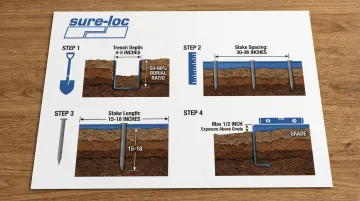
- Bury to appropriate depth - Dig trenches 4-5 inches deep, burying 50-60% of edging height for structural stability
- Secure with proper stake spacing - Drive stakes every 30-36 inches (2.5-3 feet) for optimal holding power
- Use extended stakes in challenging soils - Install 15-18 inch stakes in sandy soils or areas with significant frost heave
- Ensure level installation - Maintain consistent height above grade (maximum 1/2 inch exposure) for stability and aesthetics
Irrigation Management:
Adjust sprinkler systems to avoid constantly spraying edging. Even corrosion-resistant metals like aluminum perform better when not subjected to continuous moisture.
For in-ground irrigation, position spray heads to minimize direct contact with edging.
Drainage Considerations:
In heavy clay soils, install a gravel trench beneath the edging to improve drainage. Weathering steel and galvanized steel especially need periodic drying to maintain their protective barriers.
Annual Inspection Checklist:
- Check for loose stakes and re-secure as needed
- Look for signs of unusual corrosion (rust-through, not surface patina)
- Verify edging remains level and properly positioned
- Clear accumulated debris and organic matter from base
- Inspect joints for separation or movement
Addressing minor issues promptly prevents them from worsening and extends overall system lifespan by years.
Signs Your Metal Edging Needs Replacement
Structural Failure Indicators:
- Visible holes or perforation through the metal (not just surface rust)
- Severe warping or bending that affects edging function
- Complete loss of structural integrity where edging no longer holds its shape
- Rust-through at multiple points along the installation
Not all visible corrosion signals replacement—understanding the difference between normal patina and destructive rust is key.
Understanding Normal vs. Problem Corrosion:
Surface rust on weathering steel is normal and expected—the rust patina is the protective mechanism.
However, large rust scales peeling off (as opposed to fine powder) indicate active, destructive corrosion, often due to poor drainage or improper environmental conditions. For galvanized steel, once the zinc coating is fully compromised and red rust appears extensively, the edging is approaching end-of-life.
For aluminum, visible holes indicate extreme age or manufacturing defects, as properly manufactured aluminum should never rust through.
When to Repair vs. Replace:
Minor issues like loose stakes, small sections of coating damage, or slight shifting can be repaired. Replace when structural integrity is compromised across significant portions or when repair costs approach replacement costs.
Frequently Asked Questions
How long will metal edging last?
Lifespan varies by material: aluminum lasts 25-50+ years, weathering steel 20-50+ years, galvanized steel 20-30 years, and stainless steel 40-50+ years. Material thickness and installation quality significantly impact longevity.
What is the longest lasting landscape edging?
Weathering steel (Corten) and high-quality aluminum edging offer the longest lifespans at 40-100+ years, outlasting concrete (15-30 years), stone, plastic (1-10 years), and wood (7-15 years) alternatives. Stainless steel Grade 316 also delivers 40-50+ years in coastal environments.
Is metal landscape edging worth it?
Yes. Metal edging's longevity ($34-85/linear foot installed, lasting 20-50+ years) makes it more economical than plastic edging, which requires replacement every 3-5 years at a total cost of $16-40/linear foot over 20 years.
How much will 100 feet of edging cost?
Material costs range from $500-$3,000 for 100 feet (aluminum $600-$1,500, galvanized steel $500-$1,100, Corten $1,500-$3,000). Professional installation adds $1,000-$2,500, varying by region and complexity.
Does aluminum edging rust?
No. Aluminum doesn't rust because it contains no iron. Instead, aluminum forms a protective aluminum oxide layer that prevents corrosion while maintaining appearance. This self-healing layer reforms instantly if scratched, providing continuous protection without the "rusty" appearance of oxidized steel.
How do I maintain metal garden edging?
Metal edging requires minimal maintenance: keep drainage clear, avoid direct irrigation spray, inspect annually for loose stakes, and clean debris buildup. For coated steel, repair scratches immediately; never paint Corten steel.