
Introduction: The Foundation of Campus Appeal
Nearly two-thirds of students consider facilities when choosing their college, according to a 2022 survey. Research at the University of Texas at Dallas found that 44% cited campus appearance as a factor in their enrollment decision.
Beyond first impressions, strategic landscaping impacts student well-being, retention rates, and operational efficiency.
These impacts make landscape investment a strategic priority. The six enhancement strategies below create lasting campus appeal while optimizing maintenance budgets and supporting sustainability goals.
TLDR:
- Professional-grade edging systems reduce maintenance costs while defining campus spaces
- Native plantings cut water use by 75-95% while supporting biodiversity
- Multi-functional outdoor spaces serve as study areas, classrooms, and social gathering spots
- Strategic seasonal color programs maximize visual impact in high-visibility areas
- Smart irrigation technologies reduce water use by 30-47%
- Proactive maintenance planning spreads costs while preserving landscape quality
Why Campus Landscaping Design Matters for Higher Education
The Enrollment and Retention Connection
Campus appearance directly influences prospective student decision-making during tours and visits. At the University of Texas at Dallas, landscape enhancement projects led to 87% of users reporting an improved perception of the campus. Additionally, 70% reported enhanced quality of life after these improvements.
Well-maintained grounds provide a competitive advantage as institutions compete for enrollment. Campus tours form first impressions that often determine whether prospective students submit applications, making landscape quality a strategic enrollment tool.
Beyond recruitment, quality landscapes support the broader institutional mission of student well-being.
Student Well-Being and Academic Performance
Green spaces deliver measurable mental health benefits. A 2024 scoping review of 54 studies confirmed that over 96% found a positive relationship between campus landscapes and student mental health.
Short nature experiences of just 10-20 minutes can improve student mood by an average of 86%.
Campus green spaces support attention recovery, helping students refocus and perform better academically. Outdoor study spaces boost productivity while providing mental health benefits that contribute to academic success and student retention.
These wellness benefits translate directly into financial advantages for institutions.
Financial and Operational Benefits
Quality landscaping increases alumni donations and community engagement. Research shows that campus experience satisfaction significantly predicts alumni donation willingness at universities across multiple sectors.
Investing in durable, professional-grade materials reduces long-term maintenance costs. Harvard College's transition to organic maintenance saved 2 million gallons of water annually and $35,000 in waste removal costs.
Proper planning reduces labor requirements while maintaining the landscape quality that supports enrollment, retention, and fundraising goals.
Strategy 1: Create Defined Bed Edges and Walkway Borders
The Critical Role of Edging in Campus Design
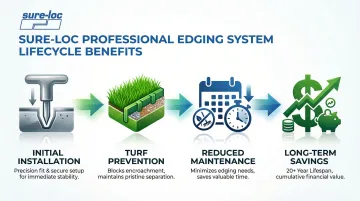
Edging creates crisp, clean lines that define spaces and distinguish professional landscaping from amateur work. Defined borders prevent turf encroachment, reduce trimming time, and maintain design integrity across large campus installations.
Edging supports all other landscape features by creating clear mowing lines, preventing mulch spillage, and establishing permanent boundaries that reduce ongoing maintenance requirements.
Professional-Grade Edging Systems
Material selection significantly impacts lifecycle costs and performance:
| Material | Expected Lifespan | Maintenance Requirement |
|---|---|---|
| Aluminum | 15-25+ years | Very Low |
| Steel | 15-30+ years | Low-Medium |
| Concrete | 20-30+ years | Medium |
| Standard Plastic | 1-10 years | High |
Professional-grade aluminum and steel systems offer superior long-term value compared to temporary plastic or rubber alternatives.
Commercial-grade aluminum edging provides lifetime performance, won't rust or crack, and uses recycled materials—aligning with campus sustainability goals.
Key features to look for:
- No-overlap joint systems that create seamless appearance and prevent separation
- Anti-frost heave technology for freeze-thaw cycle stability
- Flexible staking systems that work with campus maintenance equipment
- Dual stake locking for permanent positioning
Many landscape professionals working on educational campuses specify Sure-loc Edging's commercial-grade aluminum systems. The company has completed installations at Black Hills State University and Cornerstone University, offering dual stake locking technology and 45-degree angle stake pockets designed for freeze-thaw stability.
Implementation Considerations
Prioritize edging installation in high-visibility areas:
- Main entrances and admissions buildings
- Primary walkways and pathways
- Athletic facilities and recreation areas
- Campus monuments and signature landscape features
Work with landscape professionals who understand educational facility requirements and procurement processes. Proper edging installation reduces long-term maintenance costs by creating clear mowing lines and preventing the labor-intensive process of removing encroaching grass from planting areas.
Strategy 2: Incorporate Sustainable Native Plantings
Native plants require less water, fertilizer, and maintenance while supporting local ecosystems. The University of Nevada, Las Vegas converted over one million square feet of turf to xeriscaping, saving an estimated 55 million gallons of water per year.
The University of Arizona found that replacing lawns with native plant gardens can reduce water needs by 75-95%.
Benefits of native plantings:
- Reduced irrigation requirements and water costs
- Lower fertilizer and pesticide needs
- Improved soil health and stormwater management
- Increased habitat for bees, butterflies, and native wildlife
- Year-round visual interest with seasonal blooms and foliage changes
Implementation and Design Considerations
Select native species that provide seasonal interest through varying bloom times, foliage colors, and textures. Professional-grade edging systems help define and maintain these native planting beds, creating clean boundaries that prevent turf encroachment and reduce ongoing maintenance needs.
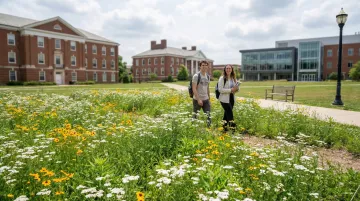
Allegheny College planted 20 species of native wildflowers to create a low-maintenance meadow that also serves as an outdoor research lab. This demonstrates how native plantings can support both sustainability and educational goals.
Student engagement through native plant education and campus biodiversity initiatives creates connections between landscape design and academic programs. These living laboratories support environmental science curriculum while reducing operational costs.
Strategy 3: Design Multi-Functional Outdoor Spaces
Students gravitate to outdoor settings for studying and socializing. Creating flexible spaces that serve as outdoor classrooms, study areas, and social gathering spots maximizes landscape value while supporting diverse campus activities.
When designing these multi-functional zones, consider these essential elements:
Essential elements for multi-functional spaces:
- Varied seating options accommodating individual study, small group work, and large gatherings
- Shade structures providing comfort during peak sun hours
- Technology integration with charging stations and WiFi access
- Durable surfaces and professional-grade edging that withstand heavy foot traffic and define pathways clearly
- Flexible furniture easily reconfigured for different uses
Leading institutions demonstrate these principles in action. The University of Hawaii at Hilo installed solar-powered recharging stations with seating, USB ports, and Wi-Fi access, while the University of Michigan features outdoor tables equipped with outlets powered by overhead solar panels.
Accessibility Considerations
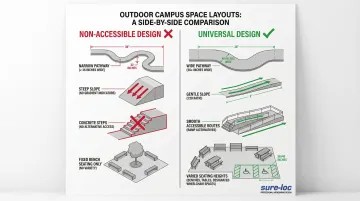
Multi-functional spaces must accommodate all students from the design phase forward. The 2010 ADA Standards require:
- Walking surfaces with running slope not steeper than 1:20
- Cross slope not steeper than 1:48
- Clear width of 36 inches minimum for accessible routes
- Wheelchair spaces at least 36 inches wide and 48 inches deep
Design pathways, seating areas, and gathering spaces with universal accessibility from the start—retrofitting later costs significantly more and disrupts campus operations.
Strategy 4: Implement Strategic Seasonal Color Programs
Focus seasonal color installations strategically on high-visibility areas to maximize impact while managing maintenance demands:
- Campus entrances and main gates
- Admissions office surroundings
- Sports facilities and event venues
- Monument signs and landmark features
Container planting strategies allow flexibility for special events and seasonal changes without the commitment of in-ground beds. Containers can be rotated, replaced, or relocated as campus needs change throughout the academic year.
When creating in-ground seasonal beds, professional-grade aluminum edging from manufacturers like Sure-loc Edging provides clean definition that highlights color displays while simplifying bed maintenance and mulch retention.
Select color palettes that incorporate school colors while maintaining aesthetic appeal. Louisiana State University uses perennials that bloom in purple and gold to reinforce institutional branding while managing maintenance costs more effectively than annuals.
Seasonal rotation best practices include:
- Rotate crops between beds to reduce disease pressure and maintain soil health
- Plan spring, summer, and fall displays for continuous color
- Schedule winter rest periods that align with academic breaks
- Use perennials as base plantings with annual accents for flexibility
Strategy 5: Optimize Water Management and Irrigation Systems
Modern irrigation technologies significantly reduce water consumption while maintaining healthy landscapes. Smart controllers deliver measurable savings across campus grounds:
- Soil moisture sensors: approximately 47% water reduction
- Evapotranspiration controllers: approximately 30% water reduction
- WaterSense-labeled controllers: up to 15,000 gallons saved annually per unit
Studies demonstrate that using water-efficient practices in institutional facilities can decrease operating costs by approximately 11% and water use by 15%.
Stormwater Management Features
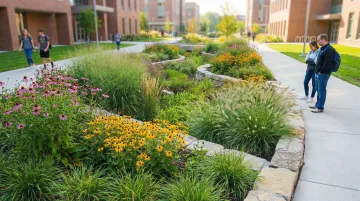
Rain gardens and bioswales function as both landscape elements and water quality improvement systems. These features offer proven pollution removal capabilities:
- Total phosphorus: 80% removal rate
- Nitrate: 78%+ removal rate
- Lead: 90%+ removal rate
A University of Maryland study documented these bioretention cell performance metrics from actual stormwater runoff testing.
Villanova University's rain garden has successfully prevented pollution from stormwater runoff for over 20 years, demonstrating the long-term performance of properly designed bioretention systems.
Campus drainage design requires integrating solutions into the overall landscape plan. Professional-grade landscape edging helps define rain garden borders and bioswale edges, creating clear separation between drainage features and pedestrian areas while maintaining the clean lines that make campus landscapes visually cohesive.
Strategy 6: Develop a Proactive Maintenance Plan
Core Maintenance Services
Essential grounds maintenance activities require proper scheduling to balance appearance with resource efficiency:
Mowing: Remove no more than one-third of the grass blade per cutting. Penn State University identified that relaxing mowing frequency from every 5 business days to every 6 or 7 days could reduce emissions by 54-60% without significantly impacting appearance.
Aeration and overseeding: Schedule 1-2 times per year, typically in spring and fall, particularly for high-use areas. This maintains healthy, thick turf that resists heavy foot traffic and reduces bare spots.
Mulch cultivation: Top-dressing shredded bark mulch every other year maintains a 2-3 inch layer while reducing costs compared to annual complete replacement.
Long-Term Planning and Budgeting
Annual maintenance expenditures for university grounds typically range from $2,500 to $4,000 per acre. APPA standards provide benchmarks for staffing ratios based on desired maintenance levels:
- Level 2 (High-level): 10.4 acres per person
- Level 3 (Moderate-level): 14 acres per person
- Level 4 (Moderately low-level): 22.4 acres per person
Multi-year landscape improvement plans spread costs over time while maintaining consistent quality. Coordinate landscape updates with building renovation projects to maximize efficiency and minimize disruption during academic terms.
Quality Materials Reduce Lifecycle Costs
Material selection directly impacts your long-term maintenance budget. Durable, professional-grade materials reduce replacement frequency and labor costs.
Professional-grade aluminum edging offers a lifespan of 25+ years compared to 1-10 years for standard plastic. This significantly reduces long-term replacement labor and material costs.
The total cost of ownership matters more than initial installation cost. Products that cost more upfront often deliver superior value over 10-20 year periods through reduced maintenance requirements and elimination of replacement cycles.
Frequently Asked Questions
What are the 5 basic elements of landscaping?
The five foundational principles are color, form, line, texture, and scale. Color creates visual interest, form defines three-dimensional shapes, line guides eye movement, texture describes surface qualities, and scale ensures appropriate sizing relative to surroundings.
How much does college campus landscaping typically cost?
Annual maintenance typically ranges from $2,500 to $4,000 per acre. Professional-grade installations cost more upfront but deliver better long-term value through reduced replacement needs and lower maintenance over 20-30 year periods.
What landscaping improvements have the biggest impact on student enrollment?
Focus on high-visibility areas like main entrances, primary walkways, and admissions building surroundings. Well-maintained grounds throughout campus matter more than isolated showcase projects, as consistency signals institutional quality during campus tours.
How can universities reduce long-term landscaping maintenance costs?
Invest in quality materials that eliminate replacement cycles, specify native plantings requiring less water, and install professional-grade edging systems that prevent turf encroachment. Smart irrigation controllers and maintenance contracts with experienced landscape companies further reduce long-term costs.
What is the typical lifespan of professional landscape edging?
Commercial-grade aluminum and steel edging systems last 20-30+ years with minimal maintenance, versus 3-5 years for plastic alternatives. Professional-grade systems withstand maintenance equipment abuse, resist frost heave, and maintain appearance without replacement. This longevity makes them cost-effective for institutional applications despite higher initial investment.
How do you balance aesthetics with sustainability in campus landscaping?
Select native plants that reduce resource consumption while providing year-round interest. Use recycled materials like aluminum edging and water-efficient irrigation. Choose durable products that don't require frequent replacement, reducing environmental impact while maintaining professional appearance.